Edmonton Divorce & Family Lawyers | Divorce, Mediation, Parenting, Child & Spousal Support, Family Property
Separation is hard. Getting clear answers shouldn’t be. Morrison LLP’s family lawyers and practicing mediators have served Edmonton families for over 40 years — whether your divorce needs a firm hand in court or a faster, lower-cost mediated settlement.
✓ Free 30-minute consultation — phone, video, or in person ✓ Lawyers AND practicing mediators in-house ✓ Family-owned Edmonton firm, 40+ years serving Edmonton & area
Call Morrison LLP at 587-758-1099 for a free 30-minute phone consultation with one of our Edmonton divorce lawyers or mediators, or book online:
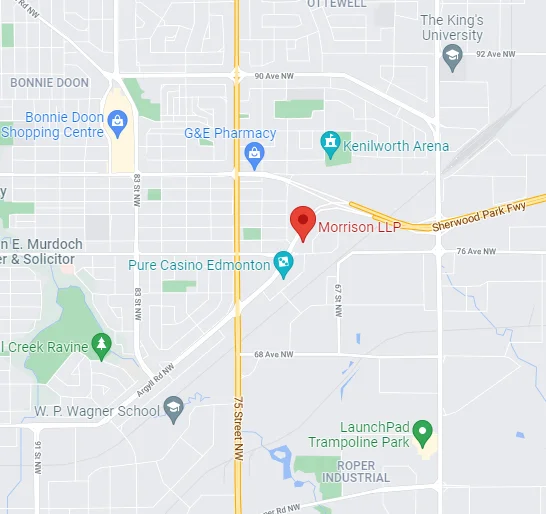
We are happy to meet in person, by phone, or by video, depending on what works best for you. Morrison LLP is conveniently located just off the Sherwood Park Freeway, at: 6940 76 Avenue, NW, Edmonton, AB T6B 2R2.
Divorce Edmonton, Alberta | Process, Costs, Mediation & Support

Important Update: Alberta’s Family Focused Protocol (Effective January 2, 2026)
As of January 2, 2026, the Court of King’s Bench of Alberta implemented the Family Focused Protocol (FFP)—a major overhaul to many family law processes.
What is the point of FFP?
FFP is designed to reduce conflict, encourage early settlement, and make court processes more consistent and efficient. In practice, it means the court expects parties to complete certain steps early—especially around information-sharing (financial disclosure) and dispute resolution (mediation/negotiation)—before they move deeper into litigation, unless the matter is urgent or exempt.
Key changes under FFP (plain-English overview)
1) Mandatory requirements (in many cases):
Before you can access certain court steps (unless urgent, waived, or exempt), parties may need to complete mandatory requirements, which can include things like:
- Parenting education (such as Parenting After Separation resources, where required)
- Attempts at early dispute resolution (mediation, settlement meetings, or other appropriate ADR)
- Financial disclosure (early and complete)
- Process steps for self-represented litigants (depending on the stream and circumstances).
2) Three “swim lanes” for family files:
FFP generally organizes files into streams such as:
- Desk (paper-based processes for certain consent/uncontested matters—often relevant to joint divorces)
- Regular (contested matters needing court decisions on parenting/support/property)
- Urgent (immediate safety or time-sensitive issues, like family violence or child safety concerns).
3) Stronger emphasis on early resolution:
FFP pushes parties toward early settlement where appropriate, which can reduce time and cost for Edmonton families—especially where the dispute is mainly about money or scheduling and not safety. Morrison LLP has experienced mediators to help you through this process, and avoid court all together.
What does FFP mean for your divorce?
For many people, it means the court will expect you to try reasonable settlement steps and provide full disclosure earlier. In practical terms, if your goal is to keep divorce costs down, your best strategy is often:
- exchange disclosure early,
- negotiate reasonably,
- use mediation where appropriate, and
- reserve court only for issues you truly cannot resolve.

What Is Divorce?
Marriage is not only a religious ceremony or romantic milestone—it is also a legal relationship between spouses. Divorce ends the legal marriage relationship.
In Canada, divorce is governed by the Canada Divorce Act, which sets out:
- the legal basis (grounds) for divorce, and
- the types of family law orders that can be made in divorce proceedings, including parenting orders, child support, and spousal support.
Divorce is often only one part of the overall legal picture. Most separated couples also need to resolve the following legal issues:
- Parenting (decision-making and parenting time)
- Child support
- Spousal support
- Division of family property and family debt.
The Three “Types” of Divorce in Alberta
Although most divorces end with a Divorce Judgment and a Divorce Certificate, the legal path to get there can look very different depending on the type of divorce.
1) Joint Divorce (often the simplest and least expensive)
Spouses can file for a joint divorce when they agree on the terms of the divorce and all corollary issues (parenting, support, and property). In a joint divorce:
- There is usually no plaintiff vs. defendant dynamic
- There is typically no requirement to formally serve divorce documents the way you do in a contested claim
- It is often the quickest and most cost-effective option
- It is commonly handled as a paper-based process when everything is settled.
Joint divorce is often ideal when spouses are civil, have already negotiated a separation agreement, and simply want to finalize the legal end of the marriage. Morrison LLP’s experienced divorce lawyers can walk you through this process, and even help on a limited scope basis to draft joint divorce documents & file them with the Court of King’s Bench.
2) Uncontested Divorce
In an uncontested divorce, one spouse starts the divorce proceedings and the other spouse does not dispute the divorce itself. Typically:
- One spouse files a Statement of Claim for Divorce
- The claim is properly served
- The responding spouse may file a document indicating they will not contest but want notice of steps, called a Demand for Notice, or they may do nothing
- The divorce proceeds as “uncontested” once the required steps are complete.
Uncontested divorce is common where spouses agree on the main issues but prefer (or require) that one person file rather than filing jointly.
3) Contested Divorce
A contested divorce usually happens when one spouse files a Statement of Claim for Divorce and the other spouse files a formal response disputing one or more issues—for example:
- parenting schedule or decision-making authority
- the amount of child support or spousal support
- property division, debt responsibility, or exemptions
- allegations around income, disclosure, or conduct affecting the children’s best interests
Important: Most contested divorces do not go to trial. In Alberta, the vast majority resolve through negotiation, mediation, or settlement processes before trial. Trial is usually a last resort for truly high-conflict or complex disputes.

How Long Does Divorce Take in Alberta?
There is no single timeline that fits every divorce. The time it takes depends on:
- the legal basis (grounds) for divorce, and
- how quickly the spouses resolve parenting, support, and property issues.
Minimum timeline (paper processing)
It can take a couple of months for the court to process the final paperwork once everything is ready—especially in joint or uncontested cases where there are no disputed issues holding things up.
However, “processing time” is only part of the story. Most divorces take longer because people still need to:
- exchange financial disclosure,
- negotiate parenting/support/property, and
- draft and sign agreements or obtain court orders.
The one-year separation reality
In most cases, the court will not grant the divorce until spouses prove the legal ground for divorce. For most families, that means one year of separation.
This is why many divorces take over one year from the date of separation, even if the legal paperwork moves quickly once filed.
What about adultery or cruelty?
Adultery and cruelty can, in some cases, allow a spouse to proceed without waiting the full year—but these grounds typically require proof and can create conflict. In practice, many people still proceed on the basis of separation because it is straightforward.
Why contested divorces take longer
When spouses cannot resolve the issues, litigation may be necessary. Litigation timelines vary widely, but contested cases often take significantly longer, especially where:
- parenting is high-conflict
- someone refuses disclosure
- property is complex (businesses, farms, corporations, pensions, valuations)
- there are allegations of family violence, addictions, or alienation
- one spouse is intentionally delaying
FFP may improve timelines in many cases, but contested litigation is still a longer and more expensive path than reasonable settlement.

How Much Does a Divorce Cost in Alberta?
It is difficult to predict the cost of divorce in advance, because the costs depend more on how the spouses behave than on the law itself.
If spouses act reasonably and exchange information early, mediation and negotiation can often resolve the main issues efficiently. If a spouse takes an unreasonable approach—refusing disclosure, forcing unnecessary court steps, or litigating every point—costs rise quickly.
The court filing fee
If you file a Statement of Claim for Divorce in the Court of King’s Bench of Alberta, the government’s listed commencement fee for divorce is $310 (fees can change over time). This is separate from lawyer fees and disbursements.
What drives divorce costs up?
We often talk about “average costs,” but what people really need is a plain explanation of what makes divorce expensive. Here are the most common drivers:
- Disclosure problems
Late disclosure, incomplete disclosure, or hiding income/assets is one of the fastest ways to increase legal fees. - Parenting conflict
Parenting disputes are often more emotional and urgent than money disputes, and they can trigger repeated court applications. - Complex property
Businesses, pensions, non-exempt/exempt property tracing, and valuations often require accountants, appraisers, or corporate records. - Unrealistic expectations
If one spouse takes a “winner-take-all” approach, the other spouse typically responds defensively—leading to prolonged conflict. - Communication warfare
Long hostile emails, late-night texts, and constant argument often become exhibits in court, generating time and fees without solving the underlying issues. - Last-minute emergencies
If people ignore the problem until the situation is urgent (cutting off funds, withholding children, freezing accounts), the legal work becomes expensive and reactive. - Multiple court appearances
Court applications require preparation, affidavits, disclosure, legal research, drafting, and attendance—costly compared to one or two good settlement meetings.
How do you keep costs down?
The single best cost-control strategy is usually:
- exchange disclosure early,
- keep communication focused on solutions,
- use mediation/negotiation wherever possible, and
- reserve court for issues that truly require a judge.
For more information, please see our practical guide on how to reduce your legal costs.

How to Prepare for Divorce (Safety + Organization + Money)
Every divorce is different, and preparation depends on your relationship and risk level. That said, the following steps help most people stay safe, organized, and financially stable.
1) Speak to a lawyer early
Friends and family mean well, but they often pass on misinformation. Divorce law is fact-specific, and “what happened to someone else” may not apply to you.
A short consultation can help you understand:
- likely outcomes in Alberta
- how to protect yourself financially
- what not to do (so you don’t accidentally damage your case)
- what documents you should gather immediately
2) Prepare financially (the overlooked reality)
Divorce often increases monthly expenses because:
- spouses move from one household to two
- each parent may need housing suitable for children
- shared bills and economies of scale disappear
- legal fees are added on top
Practical preparation can include:
- ensuring you have access to funds
- creating a realistic post-separation budget
- gathering banking records so you know what exists
- avoiding major financial decisions without advice (like liquidating investments impulsively)
3) Arrange emergency housing (hope for best, plan for worst)
You can’t always predict how a spouse will respond to separation. If there is risk of conflict escalation, plan a safe exit strategy:
- where you can stay
- how long you can stay
- how to keep the children safe
- what documents or items you must take
If there are safety concerns, talk to a lawyer urgently.
4) Change passwords and secure accounts
This includes:
- banking and investment logins
- email and cloud storage
- social media
- cell phone accounts
- utility providers
- subscription services
It is surprising how often separation disputes involve access to accounts, privacy breaches, or financial sabotage.
5) Gather important documents (before it gets harder)
Key documents often include:
- marriage certificate
- tax returns and notices of assessment (at least 3 years)
- pay stubs / proof of income
- mortgage documents, property tax statements, titles
- bank/credit card statements
- RRSP/pension statements
- insurance policies and beneficiary designations
- any agreements (prenup, cohab agreement, separation agreement).
If you don’t gather records early, you may spend money later forcing disclosure through court.
6) Talk to your spouse (if safe and possible)
Divorce works best when spouses can cooperate and focus on solving problems. If you can talk safely and civilly:
- discuss basic plans (housing, parenting schedule, bills)
- set boundaries for communication
- consider a mediator to keep discussions productive.
7) If you have children, plan parenting before you separate
Courts decide parenting based on the child’s best interests. It helps to think through:
- school schedule and transportation
- holidays and birthdays
- exchanges and pickup/drop-off logistics
- communication rules (apps, texting expectations)
- how you will handle health care and activities.
8) Update your will (and beneficiaries) after separation
Many people forget this step. Separation can create serious estate issues, and beneficiary designations on RRSPs, pensions, and insurance policies can sometimes override what a will says.
Get legal advice about timing and proper updates.

How Do I Get a Divorce in Alberta? (Detailed Step-By-Step)
Below is a practical overview of the typical divorce process. The details can vary under FFP depending on your stream and the nature of the issues.
Step 1 – Is divorce the best choice?
Many couples hit periods of serious conflict. Before you file, it is sometimes worth considering whether reconciliation is possible—especially where both spouses are open to counselling.
That said, where the relationship has broken down, divorce may be the correct and necessary step.
Step 2 – Review residency and grounds for divorce
Residency:
You can generally file for divorce in Alberta if you or your spouse has lived in Alberta for at least one year.
Grounds for divorce:
Under Canadian law, “breakdown of the marriage” is typically shown by one of:
- Adultery – Adultery is when a married person has sex with someone other than their spouse. You may file for divorce any time after you find out that your partner has committed adultery. To obtain a divorce on the grounds of adultery, you will need to show that the adultery occurred, either by proving this in court, or by providing an affidavit sworn by the adulterer.
- Cruelty – Cruelty is when one spouse commits violence, unrelenting verbal abuse, or excessive drug or alcohol abuse against their partner, such that living together has become impossible. Like adultery, cruelty must be proven to the court before a divorce may be granted.
- Separation – Separation is when you and your spouse have lived apart for at least 1 year prior to the granting of a Divorce Judgement. This is sometimes called a “no fault” divorce, because neither spouse needs to admit to any wrongdoing. Over 96 percent of divorces in Canada are no fault divorces.
a. Spouses are able to resume their relationship for up to 90 days during the 1 year separation, to try and reconcile.
b. Spouses can live separately in the same household, provided that they are no longer living together as spouses. Typically, they would need to occupy different bedrooms, and would separate their finances.
Step 3 – File and serve the divorce claim (if not joint)
If you file alone, you typically start by filing the initiating divorce documents. A claim must then be properly served.
Important: You generally cannot serve divorce documents yourself. You may need a process server or another adult to serve the documents.
After service, the responding spouse may:
- do nothing (which may allow the matter to proceed as uncontested), or
- file a defense/counterclaim (contesting one or more issues).
Step 4 – Exchange financial disclosure
Disclosure is the engine of family law. Without full disclosure, it is difficult (or impossible) to settle:
- child support
- spousal support
- division of property and debt.
Common disclosure includes:
- income tax returns and notices of assessment
- recent pay stubs
- bank statements
- credit card statements
- pension/RRSP statements
- corporate financials (if one spouse owns a business)
- property documents (mortgage, title, appraisals).
Consequences of poor disclosure:
Failure to disclose can lead to:
- adverse findings in court
- support being calculated on imputed income
- re-opening agreements or orders later
- cost consequences.

Step 5 – Resolve the dispute (best method depends on your case)
There is no one-size-fits-all solution. Most divorces resolve through one of:
1) Mediation
Mediation involves a neutral mediator helping spouses reach a settlement they design themselves.
Mediation works best when:
- spouses can remain civil and safe
- there is no serious power imbalance or fear
- both are willing to disclose finances and negotiate honestly
- issues are moderately complex (or complex but manageable with professional support).
Benefits of mediation:
- can be faster than litigation
- often less expensive than court
- tends to reduce conflict
- parties are more likely to follow agreements they helped create.
2) Negotiation
Lawyer-assisted negotiation often involves:
- exchanging proposals
- settlement meetings
- written offers
- drafting separation agreements
This approach is often ideal where:
- there is moderate conflict
- parties need strong legal guidance
- one or both spouses want the protection of lawyers, but still want to settle
3) Litigation
Litigation is a last resort. It may be necessary when:
- there are safety concerns
- a spouse refuses disclosure
- one spouse is hiding income/assets
- the parenting situation is unstable or high-risk
- negotiation has failed
Litigation is expensive and stressful, and outcomes are never guaranteed. Even strong cases carry risk.
Step 6 – Finalize the divorce (paperwork to conclude the litigation)
To finalize the divorce, additional documents are filed to obtain the Divorce Judgment. These include:
- Affidavit of Applicant for Divorce – If you filed jointly then both you and your spouse would fill this document out together. If not, then you would prepare this document yourself. This is your sworn testimony that outlines the terms of the Divorce Judgement as being the truth, the whole truth, and nothing but the truth.
- Request for Divorce – This is a short document requesting the Court to grant a divorce. You do not need to swear this document.
- Divorce Judgement (and Corollary Relief Order) – This is the order which grants the terms of your divorce. If you have children, or if there is spousal support, the Judgement will also contain an Order for Corollary Relief. This just means that it will have terms for parenting, child support, and/or spousal support.
The required documents vary depending on whether the divorce is joint/uncontested/contested, and whether there are children or support issues.

Divorce in Alberta – Key Legal Issues (What Most Divorces Actually Fight About)
Every family is different. Some couples have children, others do not. Some have significant assets, others have mostly debt. Despite the differences, most Alberta divorces revolve around four big issues:
- Parenting
- Child support
- Spousal support
- Division of family property and debt
Below is a detailed overview.

1) Parenting (Child Custody): Decision-Making and Parenting Time
In modern Alberta family law, “custody” is often discussed in terms of:
- Decision-making (who makes major decisions for the children), and
- Parenting time (when the children are with each parent)
Decision-making
Decision-making includes major choices about:
- health care
- education
- religion/culture
- significant activities
- travel and passport decisions (depending on the order)
In Alberta, many separated parents share decision-making, especially when they can communicate effectively. In high-conflict cases, courts may allocate decision-making differently.
Parenting time
Parenting time can be structured in many ways. Two common patterns:
- Primary Parenting – In this schedule, the child lives with one parent more than 60% of the time, while the other parent has parenting time less than 40% of the time. For example, if the child lives with mom, and stays with dad every second weekend, the mom is said to be the “primary parent”.
- Shared Parenting – In this schedule, the child lives with each parent more than 40% of the time (roughly 50:50). For example, the parents exchange the children on a rotating week-on/week-off schedule, then this would be considered a shared parenting arrangement.
Parenting schedules should reflect:
- the child’s age
- school schedule and stability
- parental work schedules
- distance between homes
- the child’s needs and relationships
- safety considerations
Best interests of the child
In parenting cases, the court’s focus is the child’s best interests. Section 16 of the Divorce Act lists factors courts may consider. In practice, this becomes a fact-driven assessment of stability, caregiving history, cooperation, family violence impacts, and the child’s needs.

2) Child Support
Child support is the money paid by one parent to the other to help cover the cost of raising a child.
Key principle: Child support is the right of the child, not the right of the receiving parent. Parents generally cannot “agree to no child support” in a way that defeats the guidelines and the child’s entitlement.
Base (monthly) child support
Most child support follows the Federal Child Support Guidelines. Base (monthly) support is typically:
- paid monthly
- based mainly on the payor’s income and the number of children
- adjusted in shared parenting situations (set-off may apply)
Section 7 (special or extraordinary) expenses
These often include:
- daycare/childcare
- medical/dental insurance premiums
- health expenses like braces, prescriptions, glasses
- certain educational expenses
- post-secondary tuition
- significant extracurricular activities
Section 7 expenses are typically shared proportionally to income.
When does child support end?
Child support does not always end at 18. It may continue if the child:
- is in post-secondary education, or
- cannot become independent due to health or psychological reasons (facts matter)
Enforcement: MEP
Child support orders are often enforced through the Alberta Maintenance Enforcement Program (MEP) if registered.
3) Spousal Support (Alimony / Partner Support)
Spousal support is money paid by one spouse to the other for maintenance and support. Support can be:
- monthly, or
- a lump sum (in some cases)
Unlike child support, spousal support is not automatic. The claiming spouse must usually show entitlement, such as:
Compensatory entitlement
Compensation for career sacrifices made during the relationship—for example:
- leaving employment to care for children
- relocating for the other spouse’s career
- supporting the other spouse’s education or business while losing earning capacity
Non-compensatory (needs-based) entitlement
Support based on economic hardship caused by the breakdown of the marriage—for example:
- one spouse was financially dependent
- one spouse needs time to retrain or re-enter the workforce
Contractual entitlement
Support based on agreements, such as:
- prenuptial agreements
- cohabitation agreements
- separation agreements
After entitlement is established, courts consider:
- amount (quantum)
- duration (how long support lasts)
Factors include:
- length of relationship
- age and health
- roles during the marriage
- income disparity
- childcare responsibilities
- ability for the recipient spouse to become financially self-sufficient
Spousal support orders can also be enforced through MEP if registered.

4) Division of Family Property and Family Debt
In Alberta, property division during divorce often starts from the concept of equal division, but the real analysis can be more complex—especially where exemptions apply. The governing statute surrounding the division of property is the Alberta Family Property Act.
What counts as family property?
Family property can include:
- the home and other real estate
- bank accounts and investments
- RRSPs and pensions
- businesses and corporate shares
- vehicles and personal property
- debts accumulated during the relationship
Exempt property
Certain categories of property may be exempt (or partially exempt), often including:
- gifts from third parties
- inheritances
- property owned before the relationship/marriage
- certain damage awards/settlements
- insurance proceeds unrelated to property (in some cases)
However, exemptions can be complicated. For example:
- If exempt property increases in value during the relationship, the increase may be divisible.
- If exempt funds are mixed with family funds, tracing may be required.
- If property was put into joint names, the legal analysis can change.
Agreements matter
Prenuptial agreements and separation agreements frequently affect property division outcomes. For those agreements to be effective and enforceable in Alberta, both spouses need to have independent legal advice.
Talk to a Family & Divorce Lawyer in Edmonton Today
We hope you found this legal information helpful. If you have questions about divorce, parenting, support, property division, or mediation, contact Morrison LLP.
Call 587-758-1099 for a free 30-minute consultation, or book online through the form below.
Although we are based in Edmonton (and serve Red Deer as well), our family and divorce lawyers—and practicing mediators—serve much of northern Alberta, including:
Edmonton & Area – Sherwood Park, Beaumont, Leduc, Fort Saskatchewan, St. Albert, Spruce Grove, Stony Plain.
North – Athabasca, Morinville, Westlock, Gibbons, Barrhead, Redwater, Peace River, High Level, Fort McMurray.
West – Drayton Valley, Edson, Hinton, Whitecourt, Devon.
South – Camrose, Wetaskiwin, Millet, Calmar.
East – Vegreville, St. Paul, Cold Lake, Bonnyville, Vermillion, Wainwright, Tofield.